
How to Become a Product Designer in 2026: Skills, Tools, and Career Path
Open LinkedIn right now and search "product designer." Scroll past the listings. Notice something? Half the job descriptions read like they were written for three different roles stitched together. One wants a visual design wizard. Another wants someone who can run research studies. A third wants a strategist who speaks fluent SQL. And somehow, they all share the same title.
That confusion is the biggest barrier for people trying to become a product designer. Not the tools. Not the portfolio. Not the competition. It's the fact that nobody agrees on what the job actually is, which makes it nearly impossible to figure out what to learn first.
So let's fix that.
This article ties all of that together into a single roadmap. Think of it as the hub that connects the spokes.
Here's the plan:
Define what product design actually means (and clear up the role confusion)
Assess whether you're wired for this kind of work
Break down the skills, tools, and salary ranges you need to know
Compare bootcamps and courses with real pricing (researched March 2026)
Cover interview prep, realistic timelines, and concrete next steps
No filler. No "just believe in yourself" pep talks. Straight into what works.
What is product design, really?
Product design is the discipline of shaping how digital products work, look, and feel, all while making sure those products solve real problems for real people and move the business forward. A product designer is responsible for shaping how a product looks, feels, and functions. That’s a dense sentence. Let me unpack it.
A product designer sits at the intersection of three things: user needs, business goals, and technical feasibility. Your job is to figure out the right solution (not just a pretty one), prototype it, test it, and collaborate with engineers to ship it. Product designers oversee the entire design process, from product ideation and prototyping to testing and development, ensuring each stage is focused on how to solve user problems effectively. You’re involved from problem definition to post-launch analysis.
In practical terms, your work spans user research (talking to users, analyzing data), ideation (sketching concepts, mapping flows), execution (wireframes, high-fidelity mockups, interactive prototypes), and validation (usability testing, A/B testing, tracking metrics post-launch). The product designer role encompasses a blend of creativity, technical skills, and strategic thinking. Product designers often create prototypes to visualize user flow and functionality before moving to detailed design. The emphasis shifts depending on the company, the team size, and the project stage, but you touch all of it.
Throughout the design process, product designers collaborate with stakeholders and iterate based on feedback to create user-centered solutions. After launch, product designers monitor product performance, analyzing user feedback and usage data to inform future iterations.
Clearing up the role confusion
Product design overlaps with several other design roles, which is where the confusion starts.
Product design vs. UX design: UX designers primarily focus on the user's experience, flows, usability, and research. Product designers take a broader view that includes UX, visual design, and business strategy. Many companies now use “product designer” as the default title for what used to be called “UX designer,” reflecting the expectation that you handle more of the product process.
Product design vs. UI design: UI design is a subset of product design and focuses specifically on the user interface, including visual and interactive elements such as typography, color, spacing, components, and animations. Product designers need strong UI skills but also handle the strategic and research work underneath, integrating UI design within the overall product strategy and user experience.
Product design vs. product management: Product managers define the vision and roadmap of a product, what to build and why. Product designers translate that vision into user-friendly designs, deciding how to build it. The best teams treat this as a true partnership where both sides shape each other’s thinking. You influence the roadmap; you don’t own it.
Product designers are involved in the entire design process, from user research to prototyping and testing, ensuring the product meets user needs and business goals. The role is highly collaborative, requiring effective communication with product managers, engineers, and other stakeholders.
The title matters less than the scope. When you see a “product designer” job posting, read the actual responsibilities. That tells you what you need to prepare for.
Who typically becomes a product designer?
The backgrounds of working product designers are more diverse than most career guides suggest. The “went to design school, got a junior design job, worked up” pipeline still exists, but it accounts for maybe half the field. Aspiring product designers should focus on developing relevant skills and specific skills that align with industry needs to stand out in the job market.
Visual and graphic designers make up the largest group of career changers. They already have an eye for layout, typography, and hierarchy. The gap is process: learning to think in systems, conduct research, and frame design decisions around business outcomes rather than aesthetic choices.
Front-end developers are a surprisingly natural fit. They understand technical constraints intimately, which gives them credibility with engineering teams. The transition usually means building visual design chops and learning to lead with user empathy instead of implementation logic.
People from customer-facing roles (support, success, account management) often have deeper user understanding than anyone else on the team. They’ve heard every complaint, every workaround, every frustration. Formalizing that knowledge into a research-driven design practice is the path forward.
Career changers from unrelated fields (teaching, journalism, psychology, consulting) bring transferable skills that are harder to teach: communication, synthesis, interviewing, structured thinking. Soft skills such as communication, problem-solving, and teamwork are highly valued in product design roles. What they need is technical design training and a portfolio.
A bachelor's degree in user experience design, industrial design, or a closely related field is often preferred for product designers, and degree programs can help build a strong foundation through practical experiences like internships and projects. Approximately 61% of product designers hold a bachelor's degree, while only 8% have a master's degree. Having a basic understanding of design principles and technical knowledge, such as familiarity with front-end technologies like HTML, CSS, and JavaScript, is also beneficial for career changers looking to succeed in the product designer career path.
There’s no single “right” background. What matters more is a combination of visual sensitivity, structured thinking, empathy for users, and the communication skills to explain your reasoning to people who think very differently from you.
Are you wired for product design?
Before spending months on courses and portfolio projects, run an honest internal audit. Product design has a specific daily texture that doesn’t match the glossy version you see on social media.
The work involves a lot of communication. Presenting designs to skeptical stakeholders. Writing rationale documents. Debating priorities with PMs. Defending decisions to engineers who want simpler solutions. Strong soft skills and collaboration skills are essential for success in product design, as you'll be working closely with cross-functional teams and need to communicate effectively, build consensus, and navigate feedback. If you find that energizing, you’ll do well. If it sounds exhausting, this role will drain you.
You also need comfort with ambiguity. Most product design problems don’t have a single correct answer. Effective problem solving is a key part of the role, as you’ll often work with incomplete data, shifting priorities, and competing constraints. The satisfaction comes from navigating that messiness, not from reaching a clean resolution.
And here’s the part nobody warns you about: your designs will get changed. Deprioritized. Shipped in a stripped-down version you barely recognize. Stakeholders will override your recommendations. Engineers will simplify your interactions. That’s the job. If you can separate your ego from your output and focus on the outcome rather than the artifact, you’ll thrive. If you need creative ownership and control, consider freelance design or roles with more autonomy, like brand design.
Product designer skills that actually get you hired

Mastering the top product designer skills is crucial for getting hired as a product designer. Technical skills, such as proficiency with design tools and understanding design systems, are highly valued by employers.
Understanding and applying design principles, including color theory, typography, layout, and visual hierarchy, is essential for creating effective and user-friendly products.
Participating in design challenges helps you build practical experience and showcase your problem-solving abilities to potential employers.
Project management skills are important for managing multiple projects, meeting deadlines, and collaborating with cross-functional teams.
The craft skills
User research fundamentals. You won’t run large-scale studies (that’s a researcher’s job), but you need to plan usability tests, conduct user interviews, and turn messy findings into design direction. Every team expects product designers to do lightweight research independently, using various user research methods to inform design decisions and create personas.
Wireframing and prototyping. Translating ideas into testable artifacts is your bread and butter. Mastering prototyping tools such as Sketch, Figma, Adobe XD, and InVision is essential for creating wireframes and interactive prototypes for validation. Creating mock-ups and user journey maps is a key part of the design process, helping visualize concepts and understand user interactions. Speed matters here.
Visual design and UI. Typography, color, layout, spacing, hierarchy. These aren’t decorative skills. They’re communication skills. Weak visual design undermines even the strongest product thinking. Technical skills and proficiency with design software are crucial for creating prototypes and visual assets that meet usability and accessibility standards.
Interaction design. How elements respond when users touch, click, hover, scroll. Micro-interactions, transitions, error states, loading patterns. This is what makes the difference between a mockup and something that feels alive.
Information architecture. How content and features are organized so people can find what they need. Navigation structures, labeling systems, content hierarchies. Poor IA is the silent killer of otherwise good products.
The human skills
Communication and storytelling. You'll present to leadership, write design specs, explain trade-offs to engineers, and sell ideas to people who don't think visually. This skill is the multiplier for everything else you do.
Cross-functional collaboration. Working with PMs, engineers, researchers, data analysts, and executives who all have different priorities. Navigating those relationships without losing your point of view is a daily practice.
The strategic skills
Design systems thinking. Understanding reusable components, design tokens, and patterns. Nearly every mid-to-large company runs on a design system, and you need to work within one effectively.
Business strategy and industry trends. Product designers must understand business strategy to ensure their work aligns with overall business goals and supports strategic coherence throughout the development process. Staying updated on industry trends, tools, and methodologies is essential for remaining competitive and innovative in the field.
Innovative solutions through collaboration. Developing innovative solutions often relies on collaborating with cross-functional teams, such as product managers and data analysts, to create creative and effective approaches to user and market research, as well as product development.
Data-informed design. Reading dashboards, interpreting A/B tests, using metrics to guide decisions. Designing on instinct alone doesn’t work anymore. You need to be comfortable with numbers and know when they’re telling you something your assumptions aren’t.
AI literacy. Using AI tools in your workflow (for synthesis, ideation, content) and designing AI-powered features. This went from “nice to have” to baseline expectation over the past 18 months.
Competitive edge through continuous learning. Continuously learning and adapting to new trends, mastering key design tools, and earning advanced certifications gives product designers a competitive edge, helping them stand out in the industry.
7 tools worth learning first

If you’re just starting, focus on these seven. Project management tools are essential for tracking project progress and coordinating design projects, ensuring teams stay aligned and deliver on time.
Figma is the industry standard. Collaborative, web-based, used by the overwhelming majority of product teams. Learn this first. Free for individuals, $15/seat/month for Professional.
FigJam handles whiteboarding: brainstorming, user flows, journey maps, workshop facilitation. Bundled with Figma, so most teams already have access.
Miro offers deeper whiteboarding for research synthesis, affinity mapping, and sprint planning. Overlaps with FigJam but has more flexibility for complex collaborative work.
Maze runs unmoderated usability tests directly on Figma prototypes. Quick validation without scheduling live sessions. Maze is also valuable for collecting user feedback during the design project process, helping teams iterate based on real user insights.
Notion is the documentation layer: research repos, design specs, meeting notes, project tracking. Notion also facilitates feedback collection and gathering feedback from stakeholders, making it easier to organize and act on input throughout the project.
Hotjar provides heatmaps, session recordings, and on-site surveys. Essential for understanding how people actually use a live product when you don’t have a dedicated research team feeding you insights. Hotjar is particularly useful for user feedback collection during the design project, supporting continuous improvement.
Framer bridges design and code, letting you build production-ready pages and advanced prototypes that go beyond what Figma handles. Growing fast, especially for marketing sites and landing pages.
How much can you expect to earn?
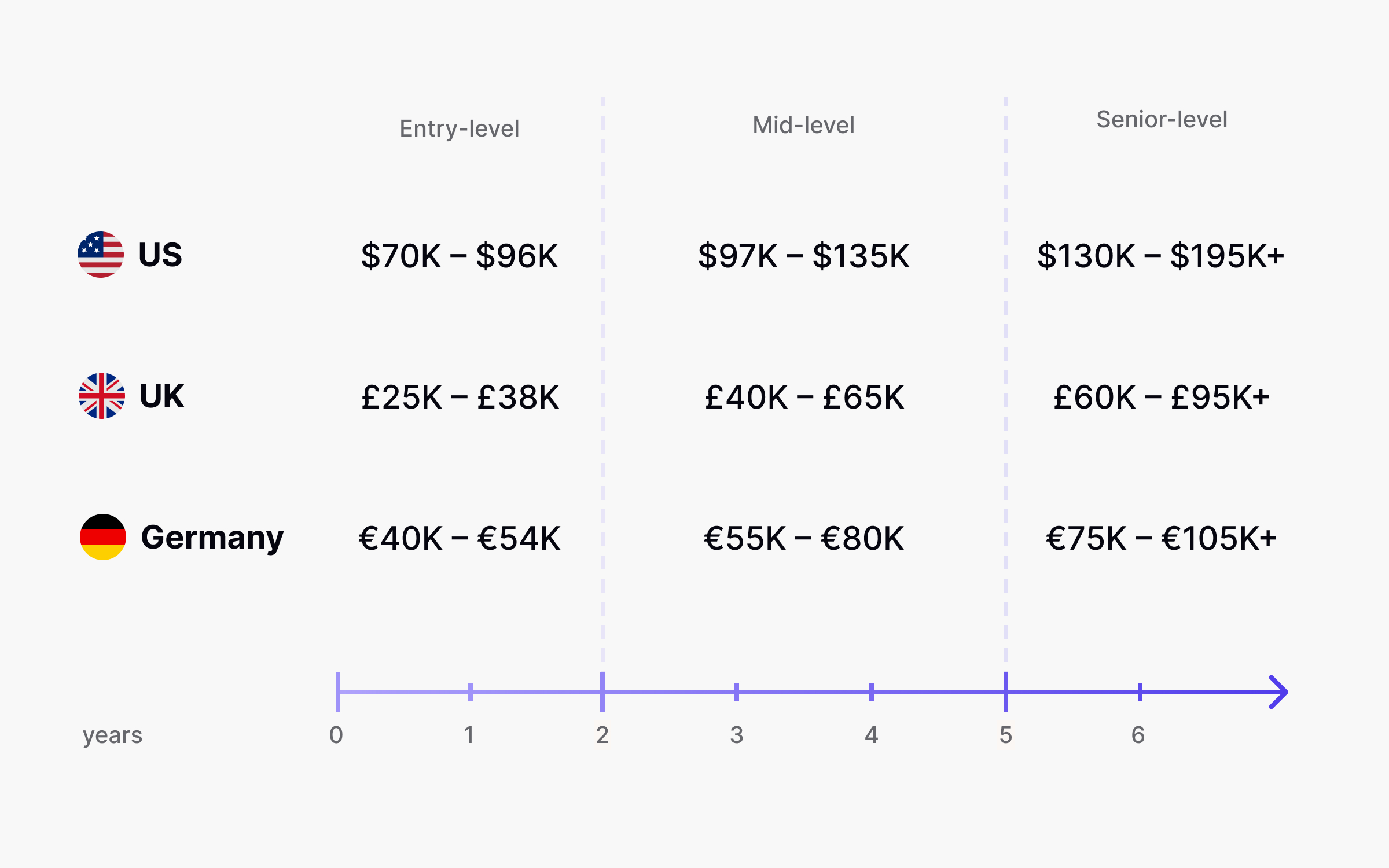
Entry-level positions are the starting point for most product designers, providing essential experience and skill development. In the field, digital product designers focus on user experience, design thinking, and collaborating across teams to deliver comprehensive digital products, while industrial designers contribute to both physical and digital product development across various industries.
Before we get into the numbers, it helps to understand what companies expect at each level, because salary bands reflect the scope of responsibility, not just years on the clock.
What's expected at each level
Entry-level product designers (0 to 2 years) execute within established systems. You're working on well-defined features under the guidance of a senior designer or design lead. The expectation is that you can take a problem that's already been scoped, produce solid wireframes and high-fidelity designs, participate in design critiques, and collaborate with engineers to ship your work. You're not expected to set design direction or influence product strategy yet. What hiring managers look for at this stage: strong fundamentals in layout, typography, and hierarchy; the ability to give and receive feedback; a portfolio showing clean process documentation; and enough research awareness to validate your own work through basic usability testing.
Mid-level product designers (3 to 5 years) own features end to end with less oversight. You're expected to lead the design for a product area or feature set: identifying the right problems to solve, running your own research, making defensible design decisions, and presenting rationale to stakeholders. You're starting to mentor junior designers and contribute to the design system. Cross-functional relationships matter more at this stage. PMs and engineers should trust your judgment, and you should be comfortable pushing back on requirements that don't serve the user. Companies also expect mid-level designers to be comfortable with data: reading dashboards, interpreting A/B test results, and using metrics to guide iteration.
Senior product designers (5+ years) shape product direction. You're no longer just executing on someone else's vision. You define the vision for your product area, influence the roadmap, and connect design work to business outcomes. You mentor other designers, raise the quality bar for the team, and often work across multiple product surfaces. Senior designers are also expected to handle organizational complexity: navigating competing priorities between teams, building alignment across stakeholders, and advocating for design quality at the leadership level. At top-tier companies, senior product designers have a measurable impact on key business metrics (retention, activation, revenue), and they can articulate that impact clearly.
Staff and principal level (8+ years) is where you're operating at the organizational scale. You're setting design strategy across product lines, defining quality standards for the entire design org, mentoring senior designers, and often working directly with VP-level leadership. These roles are rare and highly compensated. Not every company has them, but at companies that do (Meta, Google, Airbnb, Spotify), total compensation can exceed $300,000 to $500,000 when equity is included.
Building a portfolio without a job
The chicken-and-egg problem is real: you need a portfolio to get a job, but you need a job to have real projects. Three approaches work.
Personal redesign projects. Pick a product you use daily that has obvious usability problems. Redesign a specific flow, document your research, show before-and-after, and explain your reasoning. This is the most common entry-level portfolio piece, which means yours needs to stand out through rigor, not just visual polish. Show the research that informed your decisions, the trade-offs you considered, and how you'd measure success.
Volunteer or pro-bono work. Nonprofits, small businesses, and early-stage startups often need product design help and can't afford it. The work is real, the stakes are real, and you'll have to navigate actual constraints (limited dev resources, real users, real timelines). That experience reads differently on a portfolio than hypothetical redesigns.
Course-based projects. Programs like Uxcel's career path include structured project briefs (designing accessible forms, building customer journey maps, creating dashboards) that produce portfolio-ready artifacts with clear problem statements and evaluation criteria.
The strongest portfolios combine all three: one or two personal projects showing independent thinking, one piece of real-world volunteer work, and structured project briefs demonstrating foundational skills.
Is a product design career path still worth pursuing after the tech layoffs?
Product design salaries haven't dropped. Entry-level roles in the US still start at $70,000 to $96,000, and senior positions exceed $195,000. What changed is that employers are pickier. They want designers who can tie their work to business outcomes, not just ship pretty screens. If you can demonstrate impact through metrics and user research, the opportunities are there.
What's the earning potential of a product designer?
In the US, the trajectory looks like this: $70,000 to $96,000 at entry level, $97,000 to $135,000 at mid-level (3 to 5 years), and $130,000 to $195,000+ at senior level. Staff and principal roles at big tech exceed $200,000 in base salary. Total compensation at companies like Meta and Google (including equity and bonuses) can double or triple the base.
Ready to start building your product design skills? Uxcel's Product Designer career path takes you from foundations through professional certification with 18 interactive courses, real-world project briefs, and skill assessments. Join 500,000+ product professionals already learning on the platform.
Disclosure: This article includes independently researched information about product design careers, tools, and learning platforms. Course pricing and features mentioned were reviewed in March 2026 and may change over time.


